 Hammer Labs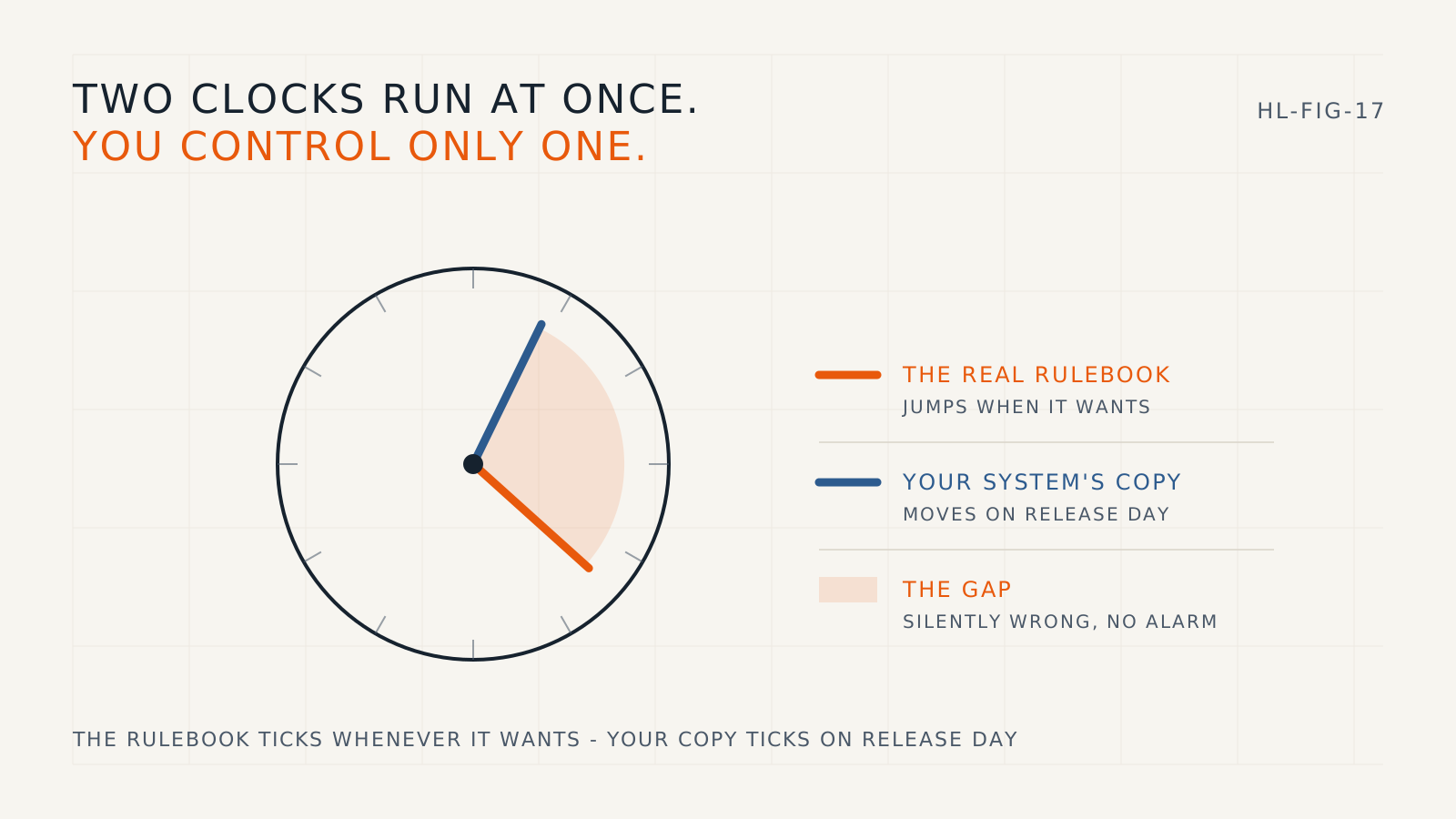
Your monitoring watches the data for drift. In regulated work the data is the calm clock. It is the definition of correct that moves, and nothing on any dashboard says so. Make the rulebook a real object, versioned and dated, and three things that are impossible today become lookups: diff two versions, ask any date, re-run a closed period.
Code is cheap now. Work that took my team a month takes a day. Everyone building software is having the same week over and over. So execution stopped being the moat, and the next thought everyone has is that imagination is the new limit. I don’t buy that either. Ideas move at the speed of a screenshot. Someone sees your product and now they have your idea, and they can build it by dinner, same as you did.
So what actually stayed expensive? In my two industries, healthcare payments and mortgage lending, the answer is the same thing, and it has a shape. This post is that shape.
Two authors, two clocks
In a normal business, right and wrong come from the world. The bridge holds or it falls. The customer buys or walks. One clock, reality’s.
A regulated business is different in one strange way. Right and wrong come from a document, and somebody else writes it. So two separate machines run at all times. The world produces events. The rulebook produces the definition of correct. Two authors, and they never talk.
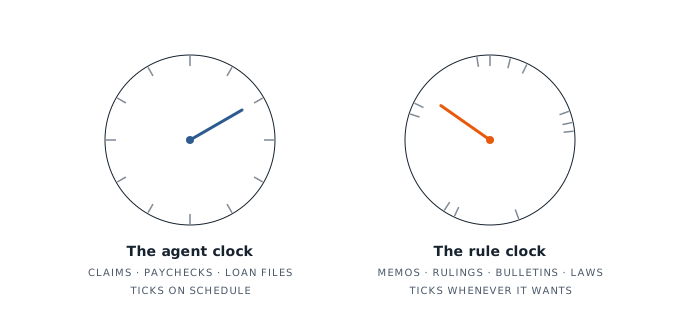
The left clock is the easy one. Claims arrive at a knowable pace. Payroll runs every other Friday. Loan volume tracks rates. Barring a black swan, next quarter looks like last quarter, and every operations team on earth is built around that fact.
The right clock is the problem. Changes land daily in some layers, monthly in others, yearly in others, from many sources at once, and sometimes with no warning at all. It doesn’t tick. It drifts.
The bucket
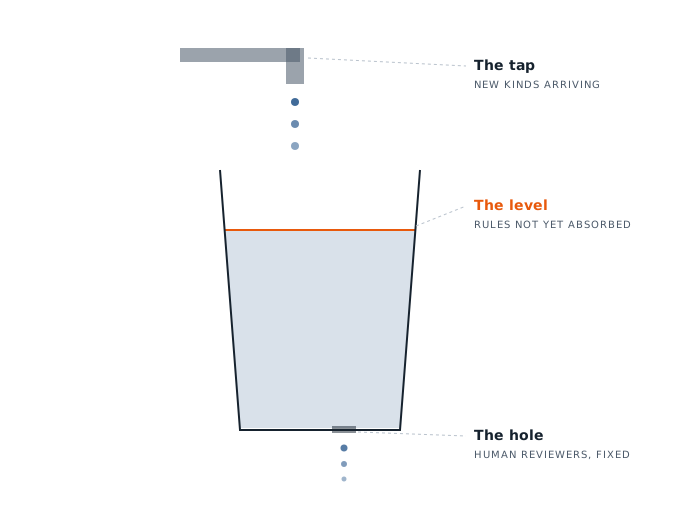
Picture a bucket with a tap running into it and a hole in the bottom.
The tap is not volume. That matters. A thousand copies of the same case is one kind of question, and you answer a kind once. The tap pours kinds. Every bulletin, every memo, every court ruling is a genuinely new question your system has never answered.
The hole is your capacity to absorb a new kind. And today, in every regulated shop I have ever seen, that hole is made of people reading. Bulletin desks. Guideline teams. Compliance. A polling loop built out of humans, and it has a fixed size.
The law with a clock on it
This bucket is a seventy year old law wearing work clothes. Ross Ashby, 1956: only variety absorbs variety. A system needs as many answers as its environment has questions. A goalie who can cover four spots cannot stop a striker who can hit six, and no amount of effort fixes the arithmetic.
Only variety absorbs variety. Ashby proved the counting version. Add a clock and it becomes a race: if questions arrive faster than you can produce answers, the shortfall does not average out. It piles up.Ashby's law, rate form
A tap running ten percent over the drain still floods the room. It just takes longer. And one honesty note if you go quote him: the race reading is a fair extension of Ashby, not a stamped theorem. Say it that way and nobody gets to dunk on you.
Here’s the twist that makes regulated industries special. Normal machine learning assumes the world moves and the answer key stays put, so all your monitoring watches the data. In these industries it is exactly backwards. The data is the calm clock. The definition of correct is the thing that moves. The whole industry points its drift detection at the stable clock and goes blind on the fast one.
Watch the gap
Blue is what your system thinks the rules are. It moves when somebody ships an update. Orange is the actual rulebook. It jumps when it wants. The shaded wedge between them is where you are wrong and nothing on any dashboard says so.
That wedge is the whole disease. Inside it your system runs on rules that are no longer the rules, with full confidence, while every accuracy number stays green. The catch-up moments are your release cycle. The jumps are the regulator’s. You only control one of them.
How long does a promise stay open
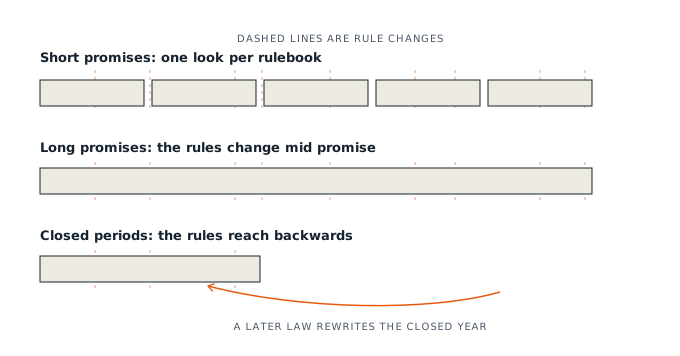
How badly the gap hurts you depends on one more variable: how long your promises stay open. Call it the duration problem. A health plan lasts a year. A mortgage lasts thirty. A tax year closes in April and then does not stay closed. Each duration gets its own flavor of pain.
Three industries, one machine
Health claims are row one. Policies reset every January, rates refile every year, the population churns on the same date. You get exactly one look per rulebook, and then the rule and the world move together, on the same morning. So when a number jumps you cannot tell if the people changed or the paperwork did. The causes share a clock. My favorite tell, from Kartik’s sign test: when one rule change pushes some subjects up and others down on the same day, the ruler moved and the world did not. That check costs one group-by and needs no ground truth.
Mortgage is row two. A loan gets decided in March under one set of guidelines, sold in June, and reviewed in November under whatever the guidelines say by then. Every buyback fight is really an argument about which version applied on the day of the decision. Version control disputes, settled by lawyers. I have watched an income calculation change overnight because one memo moved one expense factor, and every model trained on history called a few hundred unchanged borrowers weaker, confidently, in the direction every past pattern supported, on the one day the pattern stopped being true.
Taxes are row three, and everybody has personally lived them. Congress changes the answer key for years that already ended. Tip income earned in the spring got re-scored by a law passed in July. The Venmo reporting threshold moved six times in five years, once retroactively, and for a stretch the written law and the enforced law disagreed with each other. An amended return is water climbing back into the bucket. Meanwhile the tax profession has institutionalized the polling loop: continuing education is scheduled re-reading, mandated by license.
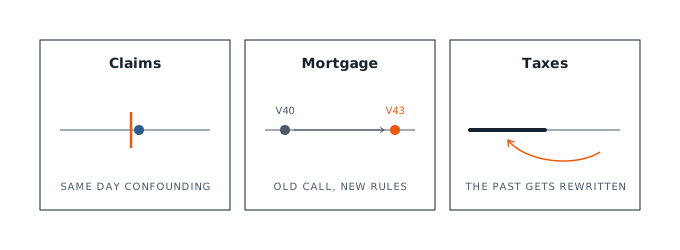
| Claims | Mortgage | Taxes | |
|---|---|---|---|
| Agent acts on | claims | loan files | returns |
| Agent clock | fast, steady | fast, steady | slow, annual |
| Rule clock | fast, many sources | fast, many sources | any speed, incl. backwards |
| Rule hides in | coder habit, edit logic | underwriter habit, LOS, overlays | software logic, preparer habit |
| Human loop | bulletin readers | guideline desks | an entire licensed profession |
| The version fight | audits, appeals | buybacks | amended returns, audits |
| Signature failure | same day confounding | judged under later rules | retroactive rewrites |
And in all three, the fix so far has been the same fix: hire people to read. You cannot hire the hole bigger. Reviewers add up in a straight line and the tap does not.
Make the rulebook a thing
The only real move is to stop working case by case, and that is what a world model is for. The trick is not intelligence. The trick is where the rules live.
Today the rulebook is smeared through everything. It sits in model weights, because the model learned from files labeled under old rules. It sits in hardcoded logic, in spreadsheets, in one veteran’s habits. Nothing carries a date. You cannot compare last year’s rules to this year’s, because the rules were never an object you could hold.
A world model makes the rulebook a thing. One place, every rule versioned and dated, kept apart from the behavior your model learns from data. Two parts, one for each clock.
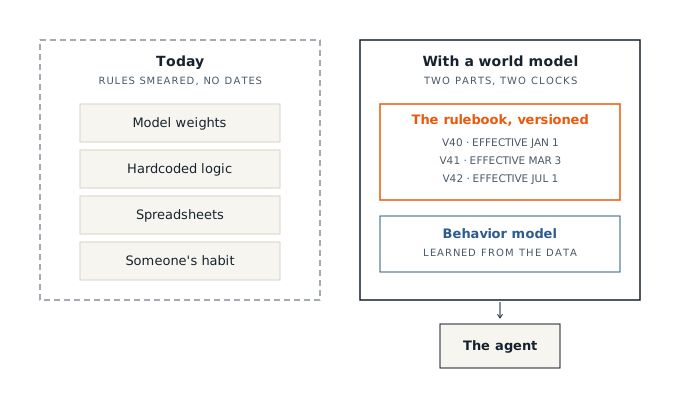
Once the rulebook is an object, three operations become possible that are impossible today, and they map one to one onto the three failures.
- Diff two versions. Breaks same day confounding, because now you know exactly what the ruler did and can subtract it.
- Ask any date. Ends the buyback fight, because what was true on the decision date becomes a lookup instead of a lawsuit.
- Re-run a closed period under a new version. That is what an amended return is. Done natively, instead of as a crisis at a strip mall in April.
Notice what this does not cost. The rules are published. Nobody has to learn a phase-in schedule from data. You type it in, exactly, with its dates, zero fitted parameters, and spend the learning budget on the only thing that needs learning, which is people. Kartik shows the rest of the mechanics in The Rules Are Half the Physics, including the taxi result I still think about weekly: the model trained on the best data scored 0.99 until the streets changed, then went to zero, while a model trained on aimless wandering held at 0.97. Accuracy measures the drain using water you already poured through it.
The hole, widened
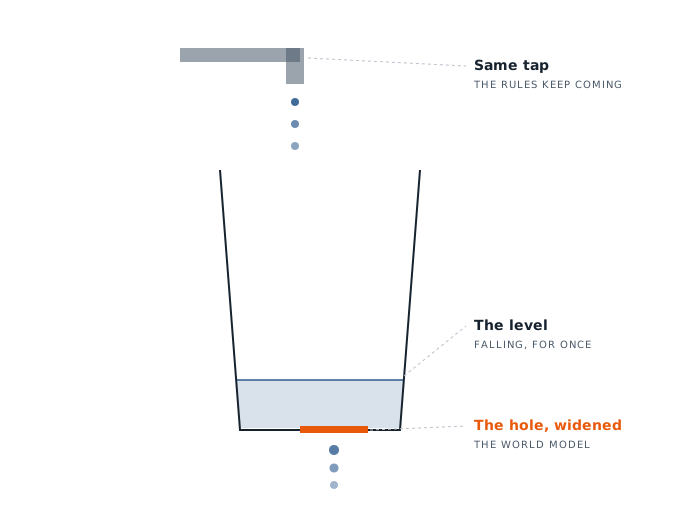
The humans do not disappear. They move up, to the rules nobody ever wrote down: enforcement posture, what one payer actually does versus another, what survives appeal. That was the only work worth paying them for anyway. Today they cannot get to it, because tier one, the published rules, has no home, so the experts spend their days reading bulletins.
And there is a fifty year old theorem waiting at the end of this. Conant and Ashby, 1970: every good regulator of a system must be a model of that system. Not have one. Be one. In these industries the system is the world plus the rulebook. So any honest model of the system must contain the rulebook, as a real object, with dates on it. If the rules are smeared through weights and habits, your model is missing half the system, and it is the half that moves fastest.
So here is the takeaway, stated plain. The speed of change was never the problem. Rules changed fast before and businesses survived. The problem is the gap between two clocks, and the gap has only one fix, because you own only one of the clocks. You cannot slow theirs. You can only widen yours.
Kartik's series builds the machinery this post gestures at: Hello World Models for the frame, The Rules Are Half the Physics for the taxi result and coherence under intervention, and Same Rule, Opposite Signs for the free test you can run this quarter.